
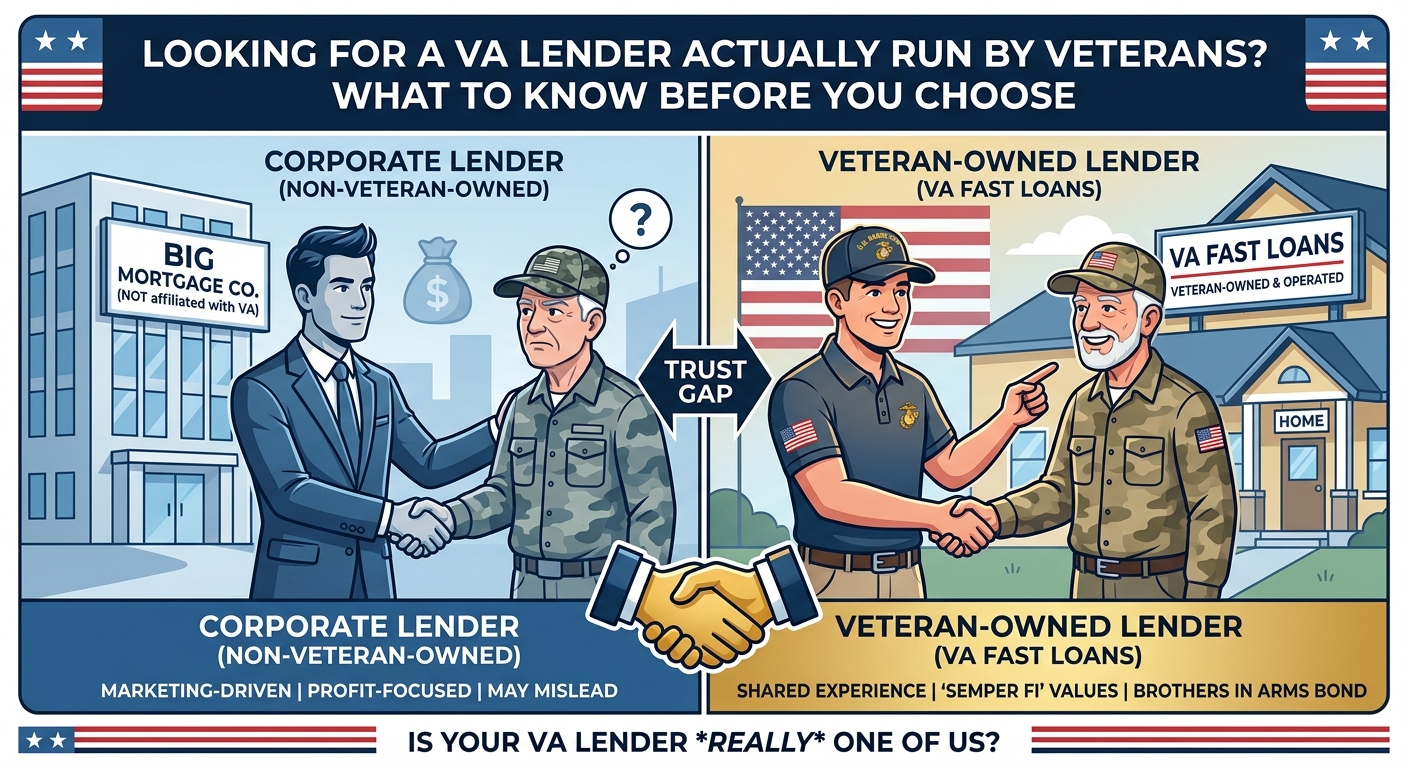
If you’re a veteran searching for a VA home loan, you’ve probably seen the ads. The name sounds official. The branding feels familiar. But here’s a question worth asking: Is the company actually operated by veterans?
For many veterans, the answer has become uncomfortable.
The Veterans United Lawsuit Controversy, Explained
Veterans United Home Loans has faced multiple lawsuits over the past year, with allegations that paint a troubling picture. According to court documents, the company is accused of misleading veterans into believing it is affiliated with the VA itself—when it is, in fact, a private, for-profit company with no government connection .
The complaints allege a “bait and switch” scheme: veterans are lured with low provisional rates, only to see those rates increase as the transaction progresses. One example cited in the lawsuit showed a rate jumping by 0.25% in just three days—while the broader mortgage market actually improved during that same period .
Perhaps most concerning: the lawsuit alleges Veterans United is not operated by veterans. The company was founded and is run by individuals with no military service, according to reporting on the litigation . The name, the branding, and the marketing were designed to blur the line between a private lender and the federal agency veterans trust.
For veterans who believed they were working with a company that shared their experience, the revelation stings.
The Trust Factor: Why Veterans Trusting Civilians With a VA Loan Is a Real Leap of Faith
Let’s be honest about something most lenders won’t say out loud: handing your VA home loan to a civilian is a leap of faith.
Your VA loan isn’t just a mortgage. It’s a benefit you earned—through deployments, through time away from family, through the kind of sacrifice most civilians will never fully understand. Entrusting that benefit to someone who has never worn the uniform requires a level of trust that has to be earned, not marketed.
And veterans are naturally cautious. We’ve learned to read people quickly. We’ve learned to spot when someone is telling us what we want to hear. So when a civilian lender promises they “support veterans” or “understand the military,” a fair question follows: Do they actually have my best interest at heart—or is this just a sales pitch?
That’s the gap. Because here’s what most veterans come to realize: when vets deal with vets, we have each other’s best interests at heart by default. It’s not a script. It’s not a training module. It’s a bond.
There’s an unspoken understanding between veterans—a shared language built on shared experience. You don’t have to explain why a PCS move is stressful. You don’t have to justify why your credit took a hit during a deployment. You don’t have to prove that your service matters. A fellow veteran already knows.
That bond changes the entire dynamic of a loan transaction. Instead of feeling like a lead in a sales funnel, you feel like a brother or sister in arms who’s being looked out for. A veteran lender isn’t just closing a deal—they’re making sure one of their own doesn’t get taken advantage of. That’s not a marketing angle. That’s who we are.
And that’s exactly why the Veterans United allegations hit so hard. Veterans trusted the name. They assumed the people behind it were “one of us.” Finding out otherwise feels less like a business disappointment and more like a betrayal.
Why Veteran-Owned Matters for VA Loans
The VA loan benefit is one of the most powerful tools veterans have. It was earned through service. And when a lender understands that—not just as a marketing angle, but as a lived reality—the entire experience changes.
A veteran-owned lender understands:
- The urgency of a PCS timeline because they’ve lived it
- The weight of a VA appraisal because they’ve waited on one
- The trust gap that exists when you’ve been burned by companies that see you as a lead, not a person
When the people processing your loan have worn the uniform, the conversation is different. The stakes feel personal—because they are. There’s a bond there. And that bond means your best interest isn’t a business strategy—it’s a responsibility.
VA Fast Loans: A Veteran-Owned Alternative Growing in California and Texas
While the giants face scrutiny, a different kind of lender is quietly gaining ground. VA Fast Loans (VAFastLoans.com) is owned and operated by Nick Velez, a U.S. Marine Corps veteran .
Velez founded VA Fast Loans with a simple mission: give veterans, service members, and their families a trusted path to homeownership—guided by the same Semper Fi values that defined his service . The team around him reflects that commitment. From loan officers to the real estate professionals in their network, the vast majority of people involved are veterans or family members of veterans . When you call, the person on the other end of the line likely knows exactly what you’re going through—because they’ve been there too.
Even the infrastructure reflects the mission: VA Fast Loans’ website is hosted by a veteran-owned web service provider—a small detail, but one that speaks to a deliberate choice to keep the ecosystem veteran-supported from top to bottom.
Growing Where Veterans Need It Most
VA Fast Loans has established a rising search engine presence in California, where the company has built a reputation for fast pre-approvals and VA loans tailored to the state’s competitive market . Now, that same veteran-first approach is expanding into Texas—a state with one of the largest veteran populations in the country.
For veterans in both states, the appeal is straightforward: a lender that doesn’t need to pretend to understand military life, because it’s run by people who’ve lived it. No translation required. No trust gap to bridge. Just veterans looking out for veterans—the way it should be.
What to Look for in a Veteran-Friendly VA Lender
Whether you choose VA Fast Loans or another lender, here’s how to protect yourself as a veteran borrower:
1. Ask who owns the company.
Don’t assume. A name with “Veterans” in it doesn’t mean veterans are running it. Look for leadership bios, ownership disclosures, and team pages that show real military service.
2. Compare Loan Estimates side by side.
The lawsuit against Veterans United centers on rate manipulation. Get at least three Loan Estimates and compare the interest rate, APR, and closing costs line by line .
3. Don’t confuse a lender with the VA.
No private lender is “the VA.” The VA guarantees a portion of your loan, but the lender sets the terms. Any company that implies otherwise is a red flag .
4. Look for veteran representation in the actual work.
It’s one thing to have a veteran in a marketing photo. It’s another to have veterans processing your loan, answering your calls, and understanding the specific financial pressures that come with military life. Ask yourself: Does this person have my best interest at heart the way a fellow vet would?
5. Check for a local presence in your state.
For California and Texas veterans, a lender with established operations in those states—and a track record of closings there—is worth more than a national call center.
The Bottom Line
Veterans deserve better than to be treated as a marketing demographic. The VA loan benefit was earned. The lender you choose should honor that—not exploit it.
There’s a trust that exists between veterans—a bond that doesn’t need to be explained to be understood. When you work with a veteran-owned lender, that bond works for you. Your best interest isn’t a talking point. It’s a promise between people who’ve served.
If you’re in California or Texas and want to work with a company where veterans are not just the target audience but the people behind the desk, VA Fast Loans is worth a conversation. Nick Velez and his team are building something different: a lender that looks like the community it serves—and looks out for it, too.
Because the question shouldn’t just be “Do you serve veterans?”
It should be: “Are you one of us?”
Ready to start your VA loan journey with a team that gets it?
Check your eligibility and connect with us, a veteran-owned team.